
Exploration guide
Mineral exploration drilling: how it works and how to read results
Last updated:
Mineral exploration drilling cuts samples of rock from below the surface so geologists can measure how much metal it contains and where.
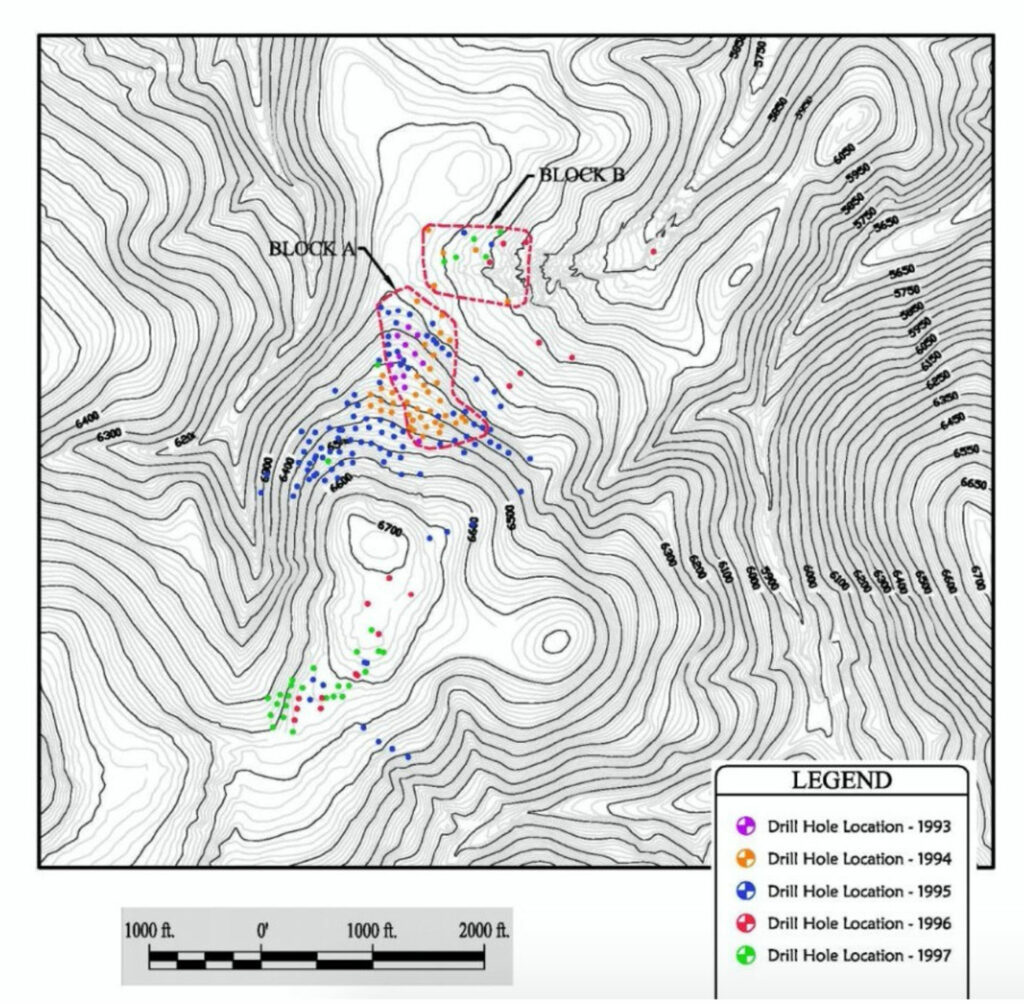
Drill results are reported as a grade over a length, such as grams of gold per tonne over a number of meters. At Lannister Mining's Basin Gulch property in Montana, more than 320 historical drill holes include intercepts like 1.8 g/t gold over 162 meters from surface, the kind of data that later feeds a mineral resource estimate.
How do you read a drill result like 1.8 g/t over 162 meters?
Read it as average grade times length. 1.8 g/t means an average of 1.8 grams of gold in every tonne of rock, and 162 meters is the length of drill core that averaged that grade. Multiply the two and you get 291.6 gram-meters, a quick way to compare intercepts of different shapes.
A short, very high-grade interval such as 156 g/t over 3 meters gives 468 gram-meters, while a long, lower-grade interval such as 0.66 g/t over 326 meters gives about 215 gram-meters. Both can matter: long, near-surface intervals suggest bulk tonnage, and high-grade hits point to richer zones. Length is drilled length, not necessarily true width.
Worksheet
Grade-thickness calculator
Enter a gold grade and an intercept length to get gram-meters. It starts with the Basin Gulch intercept of 1.8 g/t over 162 meters, as reported by Lannister Mining.
Assumptions: grade is a simple average over the full length; 1 meter equals 3.28084 feet; true width, density and metallurgical recovery are not considered.
Definition
What is mineral exploration drilling?
Mineral exploration drilling is the process of boring holes into rock to recover samples for assay, so a company can test whether a target contains metal and in what quantity. The two common methods are diamond core drilling, which recovers a solid cylinder of rock, and reverse circulation drilling, which returns rock chips and is usually faster and cheaper.
Each hole is logged and sampled in intervals, then sent to a laboratory. Results are reported as grade over length. Lannister Mining's Basin Gulch property has more than 320 historical holes, and the company plans new drilling to confirm historical intercepts and expand known mineralization, open at depth and along strike.
By the numbers
Basin Gulch drill highlights
- at 1.8 g/t Au, from surface
- 162 m
- at 0.66 g/t Au, from surface
- 326 m
- at 3.2 g/t Au, from surface
- 72 m
- at 156 g/t Au
- 3 m
Which is better, core or reverse circulation drilling?
Neither is better in every case. Core drilling gives the most geological detail and is preferred for confirming key intercepts; reverse circulation is faster for covering ground. Many programs use both.
| Method | Sample | Geological detail | Speed and cost |
|---|---|---|---|
| Diamond core | Solid rock cylinder | High: structure and texture preserved | Slower, higher cost per meter |
| Reverse circulation | Rock chips | Moderate | Faster, lower cost per meter |
| Trenching | Surface channel samples | Surface only | Low cost, shallow |
Procedure
From drill hole to published result
Plan the hole
Geologists pick a collar location, angle and depth to test a target.
Drill and recover samples
Core or chips come up and are boxed or bagged by depth.
Log and split
Rock types and features are recorded; samples are cut into intervals.
Assay
A laboratory measures the gold and silver content of each interval.
Report
The company publishes grade over length, with quality control checks.
Drilling questions
Short answers here. The full mineral exploration FAQ has more.
What is mineral exploration drilling?
Mineral exploration drilling cuts holes into rock to collect samples from below the surface, so geologists can measure grade and map mineralization in three dimensions. Common methods are reverse circulation, which returns rock chips, and diamond core, which returns solid cylinders of rock. Basin Gulch has more than 320 historical drill holes, according to Lannister Mining.
How do you read a drill result like 1.8 g/t Au over 162 meters?
Read it as an average grade over a length: here, 1.8 grams of gold per tonne of rock across 162 meters of the hole. Multiplying grade by length gives a rough grade-thickness figure, about 291.6 gram-meters in this case. This Basin Gulch intercept, listed by Lannister Mining, starts at surface, which is why it draws attention.
What does g/t mean in gold exploration?
g/t means grams per tonne, the standard unit for gold and silver grades. One gram per tonne equals one part per million by weight. Basin Gulch drill highlights published by Lannister Mining range from 0.66 g/t gold over 326 meters to 156 g/t gold over 3 meters, which shows why length matters as much as grade.
What are the best historical drill results at Basin Gulch?
Highlights listed by Lannister Mining include 1.8 g/t gold over 162 meters from surface, 0.66 g/t gold over 326 meters from surface, 3.2 g/t gold over 72 meters from surface, 156 g/t gold over 3 meters and 25 g/t gold over 14 meters. These are historical results the company plans to confirm with new drilling.
What does near-surface mineralization mean?
Near-surface mineralization means metal-bearing rock starts at or close to the ground surface rather than deep underground. That can matter because shallow material is generally cheaper to reach. Several historical Basin Gulch intercepts listed by Lannister Mining begin at surface, including 1.8 g/t gold over 162 meters and 0.66 g/t gold over 326 meters.
What does it mean that gold is hosted in oxides?
Oxide-hosted gold sits in rock that weathering has oxidized, which often makes the gold easier to recover than gold locked in fresh sulfide rock. Lannister Mining states that Basin Gulch mineralization is hosted in oxides. Actual recovery at any project is confirmed only through metallurgical testing, so check company technical disclosures for those results.