
The district
The Philipsburg Mining District, then and now
Last updated:
The Philipsburg Mining District is a historic silver and gold mining area around Philipsburg in Granite County, Montana, and home to the Basin Gulch gold-silver property.
Lannister Mining describes the Philipsburg Mining District as the district that led the original US silver boom of the late 1800s. Today Lannister Mining is exploring Basin Gulch there, a property with near-surface, oxide-hosted gold-silver mineralization and more than 320 historical drill holes, bringing modern exploration to a district best known for silver.
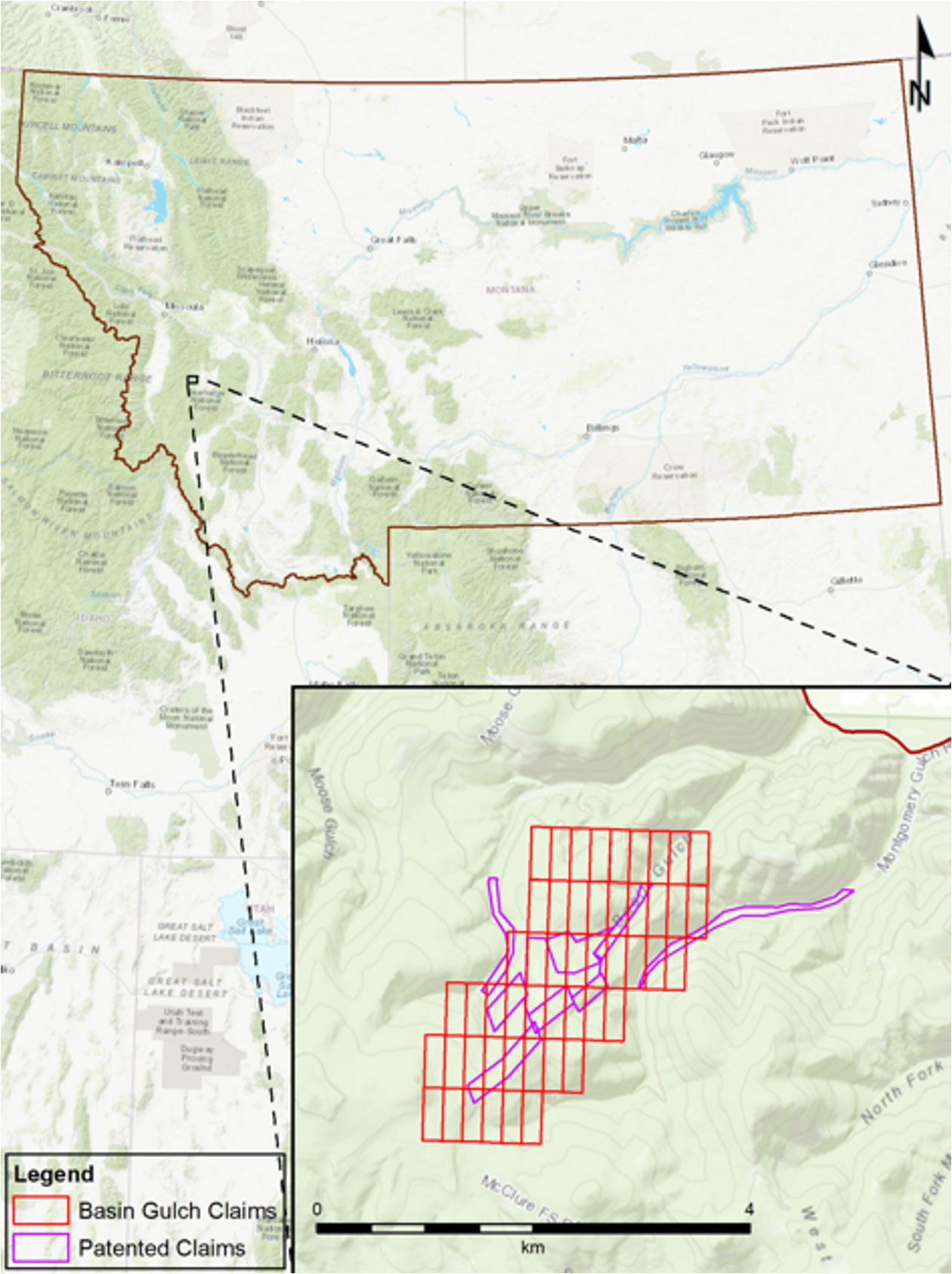
Where is the Philipsburg Mining District and what was mined there?
The district surrounds the town of Philipsburg in Granite County, west-central Montana, and is also listed as the Flint Creek Mining District on Mindat. Silver made it famous: according to the University of Montana's This Is Montana column, one Philipsburg-area mine, regarded as the greatest silver bonanza of its time, produced $20 million in silver between 1885 and 1893.
Public records also list manganese deposits studied by the US Geological Survey, rhodochrosite from the Algonquin Mine and malachite specimens. Most pages about the district focus on that history and on mineral specimens. What they rarely cover is current exploration: Basin Gulch, with its gold-silver oxide mineralization, is an active modern project in the same district.
Definition
What is a mining district?
A mining district is a named area where prospectors and miners historically recorded claims under shared local rules. Many western US districts date from the 1800s, and their names still appear in geological reports, mineral databases and claim records.
The Philipsburg Mining District is one of Montana's best known. Lannister Mining describes it as the district that led the original US silver boom of the late 1800s, and it is where the company's Basin Gulch property sits. The area is reached from the town of Philipsburg, and Butte is about one hour from the property. For investors, a historic district can mean decades of geological records, existing roads and a community familiar with mining.
Timeline
From silver boom to modern exploration
1852
First gold discovery in the Montana territory, at Gold Creek near present-day Garrison.
Late 1800s
The Philipsburg district leads the original US silver boom.
1885 to 1893
One Philipsburg-area mine produces $20 million in silver, per the University of Montana.
1987 to 1997
Historical drill programs at Basin Gulch, including a 1989 Chevron program, per the company property map.
Today
Lannister Mining plans confirmation and expansion drilling at Basin Gulch.
What minerals are recorded in the Philipsburg Mining District?
| Mineral | Where recorded | Public source |
|---|---|---|
| Silver | Philipsburg-area mines | University of Montana |
| Manganese | Philipsburg, Granite County | US Geological Survey publication |
| Rhodochrosite | Algonquin Mine | Mineral specimen listings |
| Malachite | Philipsburg (Flint Creek) district | Mindat |
| Gold and silver in oxides | Basin Gulch property | Lannister Mining |
Further reading: Western Mining History on Philipsburg, Montana.
Why explore for gold in a district known for silver?
Because the geology that produced silver can also host gold, and Basin Gulch has the drill data to show it. Historical intercepts reported by Lannister Mining include 1.8 g/t gold over 162 meters from surface and 3.2 g/t gold over 72 meters from surface, with silver present in trench results such as 5 g/t gold and 54 g/t silver over 34 meters.
Philipsburg Mining District questions
Short answers here. The full mineral exploration FAQ has more.
What is the Philipsburg Mining District?
The Philipsburg Mining District, also listed by Mindat as the Flint Creek Mining District in Granite County, is a historic mining area around Philipsburg, Montana. Lannister Mining describes it as the district that led the original US silver boom of the late 1800s. The Basin Gulch property sits in this district.
What was mined in the Philipsburg Mining District?
Silver made the district famous. The University of Montana's This Is Montana column describes one Philipsburg-area mine, regarded as the greatest silver bonanza of its time, that produced $20 million in silver between 1885 and 1893. Public mineral records also list manganese, rhodochrosite and malachite from the district.
What minerals are found around Philipsburg, Montana?
Public records for the Philipsburg area include silver ores, manganese deposits studied by the US Geological Survey, rhodochrosite from the Algonquin Mine and malachite specimens catalogued by Mindat. Gold and silver are the focus at Basin Gulch, where Lannister Mining reports near-surface gold-silver mineralization hosted in oxides.
Where is the Basin Gulch property?
The Basin Gulch property is in west-central Montana, in the historic Philipsburg Mining District. Lannister Mining states it has year-round access from Philipsburg on paved and well-maintained gravel roads and sits about one hour from Butte. The location map on the company property page shows the claim block in the forested mountains of western Montana.
How far is Basin Gulch from Butte?
Lannister Mining states that the Basin Gulch property is only one hour from Butte, Montana, with year-round access from Philipsburg on paved and well-maintained gravel roads. Year-round access matters for exploration because drill programs, sampling and site visits do not have to stop for a winter season.
Why explore for gold in Montana?
Montana is known as the Treasure State because of its mineral wealth and long mining history, and mining still plays an active role in its economy. Gold was first discovered in the Montana territory in 1852 at Gold Creek, near present-day Garrison. Lannister Mining chose Basin Gulch partly for this jurisdiction, which it describes as safe.